Cooper is the film's center of gravity — a man engineered by circumstance to be the pivot on which humanity turns. He is a former NASA pilot turned farmer, living in a civilization that no longer needs explorers, and the film's first act is largely about the corrosive effect of having a vocation and being denied it. McConaughey brings an effortless physicality to the role; his Cooper moves through scenes with the easy confidence of someone who understands machines. But the performance's depth is in the moments of stillness: the tape-recorded messages from Earth piling up unwatched, the quiet devastation when he realizes what the arithmetic of time dilation has cost him. Cooper is not a tragic hero in any classical sense — he does not fail from hubris. His tragedy is that he was exactly right: about the mission, about Murph, about love as mechanism. And it still cost him everything. What drives him is not ambition but fidelity — to his children, to the mission, to the belief that both of these loyalties are ultimately the same.
A Film by Christopher Nolan • 2014
INTERSTELLAR
Mankind was born on Earth.
It was never meant to die here.
A Film About Everything That Matters
Christopher Nolan's Interstellar is the rare blockbuster that takes seriously the things science fiction usually treats as backdrop: the irreversibility of time, the terror of abandonment, the question of whether love can be measured. Set against a dying Earth and the incomprehensible scale of interstellar space, it is, underneath all of that, a film about a father and a daughter — and the cost of choosing the world over the people in it.
Released in November 2014, the film earned near-universal respect for its visual audacity and Hans Zimmer's monumental score while dividing critics on whether its emotional ambitions outran its philosophical reach. In the decade since, it has accumulated a devoted following who return to it not for answers but for the feeling — that vertiginous sensation of watching time stretch and love persist across distances that should make both impossible.
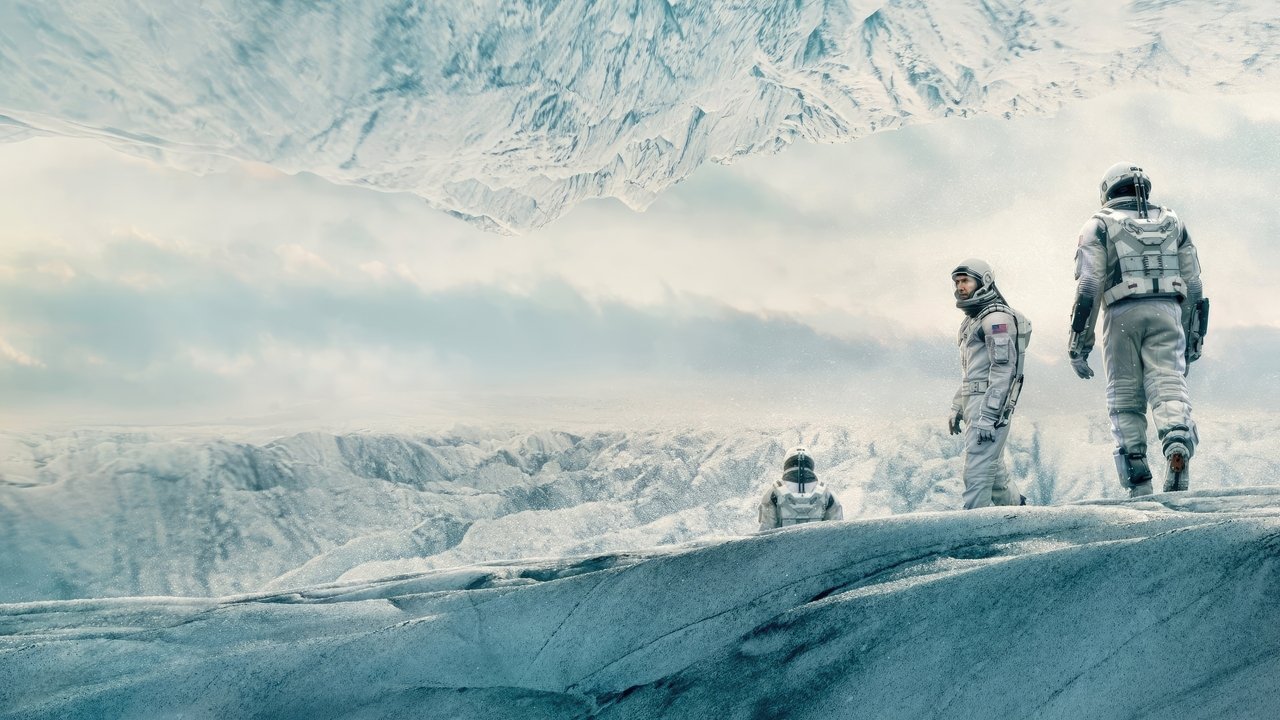
INTERSTELLAR
The Gravity of Leaving
Interstellar is, at its core, a film about the impossibility and necessity of letting go. Set against a near-future Earth suffocating under crop blight and dust, Christopher Nolan frames his most emotionally naked film as a paradox: to save humanity, Cooper must abandon the only human relationship that gives his journey meaning. The film's genius is in making this sacrifice feel both cosmically inevitable and personally devastating at the same time.
The first act establishes not a failing civilization but a failing relationship. Cooper is not primarily an engineer or an astronaut in these opening scenes — he is a father caught between the gravitational pull of fatherly presence and the even more powerful pull of a mission that only he can complete. Nolan makes the domestic setup earn its length, because the wrenching quality of the film's middle section — the time-dilation sequences on Miller's planet, where an hour costs seven years — depends entirely on how much we've invested in the tie being stretched. By the time Cooper watches two decades of tape-recorded messages from Earth in a single sitting, the mathematics of relativity have been given a human weight that no physics textbook can replicate.
The film's structural pivot occurs not at the wormhole but at the moment on Miller's planet when the wave arrives. What should be a scientific setback becomes a scene of obliterating grief. Cooper's helplessness — watching the clock tick, doing the arithmetic, understanding that Tom is now an adult and Murph's childhood is irretrievably gone — is among the most precisely calibrated pieces of emotional filmmaking in Nolan's career. The horror is not spectacle; it's arithmetic.
The Dr. Mann sequence that follows is an act of structural bravery. Mann does not fail from malice but from the most human of impulses: the desire to survive, and the rationalizing machinery the mind deploys to justify it. His deception and its catastrophic consequences force the mission into its final configuration — Brand heading to Edmunds, Cooper falling into Gargantua — and complicate the film's otherwise optimistic view of human nature. Nolan is careful to make Mann sympathetic even as he destroys everything around him. What Mann lacks is not intelligence or courage, but the connective tissue of love that gives Cooper his compass.
The tesseract sequence is the film's most abstract achievement and also its most emotionally precise. Cooper, suspended in a five-dimensional construct built by future humanity, realizes he is the ghost — the presence that Murph sensed as a child, the force that has always been trying to reach her across time. The revelation reframes everything that came before: his irrational insistence on returning, Murph's obsession with the gravitational anomaly, the watch as a physical object carrying data across decades. Nolan collapses the film's entire timeline into a single impossible room where past, present, and intention coexist, and makes it feel not like a clever plot mechanism but like a statement about the nature of love itself.
The ending refuses easy catharsis. Cooper reunites with an aged Murph on Cooper Station — she is old and dying; he is unchanged — and the scene carries a peculiar bittersweet quality that Nolan refuses to soften. The mission's success cannot undo the fact that she grew up feeling abandoned. She has lived her full life without him. He is then sent away again, toward Amelia Brand on Edmunds' planet, and the film ends before he arrives. This is exactly right. Interstellar is not about resolution. It is about the vectors of love across impossible distance — and the understanding that those vectors, once set in motion, never stop.
"Love is the one thing we're capable of perceiving that transcends dimensions of time and space." — Dr. Amelia Brand
What the Film Is Really About
Time as Loss
The film's central emotional instrument is not the wormhole or the black hole but the tape recorder. Cooper watches messages from home that accumulate faster than he can process them — Murph's years condensed into minutes, Tom's entire transition from child to adult played in a sequence that is devastating precisely because nothing dramatic happens. A farm. A wedding. A grave. Nolan understands that the horror of time dilation is not the physics but the arithmetic: what costs Cooper an hour costs Murph twenty-three years of waiting. The film never lets us forget that cosmic scale and human scale are measuring the same events with entirely different instruments — and that the gap between those instruments is grief.
Love as Mechanism
Interstellar stakes its central philosophical claim carefully and then defends it until the final frame: love is not sentiment or biology, but a vector across spacetime that future humanity has learned to map. Cooper's gravitational anomalies are not coincidences; they are messages, encoded by love across a time loop that the film slowly reveals to be closed and pre-determined. Whether this is beautiful or troubling depends on where you stand — is it reassuring that love has physical weight, or is the film's determinism quietly claustrophobic? Nolan holds both possibilities without resolving them. The film believes in love as a force of nature with the same seriousness that it believes in relativity.
The Ethics of Leaving
The film's most uncomfortable question is one it never fully answers: was Cooper right to go? He leaves a ten-year-old daughter on the understanding that millions of future lives justify the sacrifice of one family's present. The utilitarian calculus says yes. But Murph's anger — which persists for decades, which she carries into old age — suggests that the philosophical justification doesn't actually heal the wound. Cooper saves humanity and loses his daughter's childhood. These things are both true simultaneously, and Nolan refuses to weigh them against each other or to let the mission's success erase the cost. It is a film that trusts its audience to hold contradictions without resolution.
"Interstellar represents more of the thrilling, thought-provoking, and visually resplendent filmmaking moviegoers have come to expect from writer-director Christopher Nolan, even if its intellectual reach somewhat exceeds its grasp." — Rotten Tomatoes, based on 375 reviews
The People in the Equation
Murph is the film's other center, and Nolan wisely keeps her in parallel rather than subordinate to Cooper's narrative. The film belongs to her as much as to her father. Young Murph, played by Mackenzie Foy with a watchfulness beyond her years, is all curiosity and wounded dignity — a child who refuses to name her ghost because naming it would make her father's departure feel fated. Chastain's adult Murph carries that wound into her work, channeling abandonment into obsession and obsession into breakthrough. Her arc is about the hardest kind of forgiveness: the kind that arrives not through resolution but through understanding. When she realizes that her father was the ghost all along, the revelation is not reassuring — it means her lifelong resentment was aimed at the very person trying to save her. Chastain plays this with extraordinary restraint, letting the mathematics of the moment do the emotional work. Murph proves Brand's thesis not by believing it but by solving for it, which is the film's most quietly radical statement about what love actually looks like when it enters the world as action.
Brand is the film's most philosophically loaded character, and Hathaway navigates the challenge of making a walking thesis feel genuinely human. Her famous speech about love as a quantifiable force is the film's riskiest gamble — is she right, or is she rationalizing grief? The film ultimately vindicates her, but only partially. She is correct that love is a force, but her specific hope — that Edmunds' planet is viable because she loved Edmunds — is also, at least in part, self-deception dressed as science. Nolan uses Brand to interrogate the gap between intuition and evidence throughout the film. She is the character who has already crossed the line that everyone else is still approaching, who has already accepted that human emotional experience might be epistemologically valid in a scientific sense. She arrives on Edmunds' planet at the film's end not as a triumphant scientist but as someone who must build a civilization alone, on a faith that cannot yet be verified. The film's final image of her — a single figure on an alien world, beginning — is its most quietly harrowing.
Mann is the film's most carefully constructed psychological trap. He arrives as a relief — Damon's casting signals trustworthiness before he's said a word, a deliberate piece of manipulation that implicates the audience in his deception — and his breakdown is all the more disturbing for how relatable it is. Mann did not become a villain from malice but from the most human of impulses: the desire to survive, and the rationalizing machinery that the mind deploys to justify that desire. His planet is beautiful and lethal, and his choice to falsify its data rather than accept a meaningless death is the film's argument against pure survivalism stripped of human connection. Mann represents what humanity becomes without love as a connective force: technically capable, grandiosely self-narrating, catastrophically self-serving. He genuinely believes he is saving the species. His death — abrupt, undignified, the consequence of overconfident action — is exactly right for a character whose inflated sense of self-purpose destroyed everything it touched.
TARS is the film's quiet triumph. A blocky, articulated machine with no face and no organic warmth, voiced by Bill Irwin with a dry wit that feels genuinely earned, TARS functions as the film's moral compass in the precise way that the more ostentatiously human characters cannot. Its adjustable honesty setting — established early as a running joke — becomes the film's most quietly profound gesture: TARS can choose how truthful to be, and chooses a calibration that prioritizes human functioning over literal accuracy. This is not duplicity. It is wisdom. TARS enters the black hole voluntarily. It transmits the quantum data that enables Murph's equation. It performs these actions without ceremony or apparent self-interest, making it the film's most selfless character by a considerable margin. Nolan uses TARS to ask whether humanity's defining qualities — empathy, sacrifice, adaptive honesty, the ability to hold back a hard truth for the sake of someone who needs hope — can be engineered. And if they can be engineered, whether that makes them any less real.
Five Arguments the Film Makes
Love Is a Fundamental Force of Nature
The film's most audacious claim is delivered quietly, mid-mission, by a scientist who is also grieving: that love is not a biological accident or a cultural construct but a quantifiable force that operates across dimensions. It is easy to dismiss this as sentiment wearing a lab coat — several critics did — but Nolan is making a more precise argument. He is saying that the tesseract exists because future humanity understood something about gravity that we do not yet: that emotional bonds create measurable fields. Cooper's ability to locate Murph's room across time is not metaphorical. The watch works. The data transmits. Love, in this film's physics, has mass. What is philosophically serious about this is not the science-fiction premise but what it implies about the relationship between internal experience and external reality. Interstellar proposes that human consciousness — specifically the part of it that forms attachments — is not epiphenomenal noise but a structure capable of doing work in the physical world. This is not a new idea in philosophy, but it is radical territory for a blockbuster, and Nolan commits to it without hedging.
Sacrifice Is Most Meaningful Without Guarantee
Every major sacrifice in Interstellar is made without the assurance of a good outcome. Cooper leaves not knowing if the mission will succeed. Brand continues to Edmunds' planet alone, not knowing if she is building a civilization or building a monument to futility. TARS enters the black hole with a reasonable probability of functional destruction. Even young Murph, receiving her father's "STAY" message from across time, has to decide whether to trust a force she cannot see or explain. The film is interested in what it means to act on love when the cost is concrete and the return is theoretical. It refuses the comfortable calculus of certain heroism — nobody in this film gets to sacrifice themselves with the reassurance that it will work. The emotional weight of the tesseract sequence comes precisely from the fact that Cooper is transmitting data across a time loop that, from inside it, feels indistinguishable from madness. He acts on love without confirmation that love is sufficient. This is the film's definition of faith, and it places that faith firmly in the secular register of human attachment rather than the transcendent.
The Closed Loop: Agency Within Determinism
One of the film's most quietly unsettling philosophical implications is that the loop is closed before it begins. Cooper was always the ghost. He always sent the message. The tesseract was always built by future humanity using the quantum data that TARS always collected after Cooper always fell into Gargantua. There is no branching timeline, no moment where a different choice could have been made. This creates a specific kind of dread beneath the film's emotional warmth: the feeling that every character is executing a script they cannot read but cannot deviate from. And yet the film presents this determinism not as a cage but as a kind of grace. The fact that the loop closes does not diminish Cooper's love — it is, in the film's cosmology, the mechanism by which love becomes physically effective. Nolan is making a subtle argument about agency: that doing what you were always going to do is not meaningless if you do it from genuine feeling. The absence of alternatives does not void the moral weight of the act. Love doesn't need contingency to be real.
Scientific Reason and Human Intuition Are the Same Project
The film's most structurally important argument is that the division between rational analysis and emotional intuition is a false one. Murph's breakthrough is not achieved by abandoning feeling in favor of equations — it is achieved by following an obsession that began with a ghost and a watch. Brand's decision to trust love as data does not undermine her scientific method; it expands it. The film's antagonist — to the extent that it has one — is the brand of pure survivalism that Mann represents: reason stripped of attachment, calculation divorced from the question of what the calculation is for. Professor Brand's deception is a more insidious version of the same error: he withholds the truth not from malice but from a kind of intellectual paternalism, deciding that hope is more useful than facts. Interstellar argues that the most rigorous thinking is the thinking that takes seriously what matters — and that attachment, far from being a bias to overcome, is part of what makes a mind worth having in the first place.
The Parent-Child Bond as the Unit of History
Beneath all its cosmological architecture, Interstellar is a film about what parents owe children and what children owe parents — and the uncomfortable answer it gives is: everything, imperfectly, across whatever distance gets in the way. Cooper's greatest achievement is not flying through a wormhole or surviving a black hole. It is managing to remain, in some form, a presence in his daughter's life despite the most extreme physics the universe can deploy against him. Murph's greatest achievement is not solving the gravity equation. It is forgiving her father for leaving while he is still, cosmically speaking, in the process of trying to reach her. The film uses the scale of space travel to make legible something that happens in ordinary life: the way parents and children lose each other gradually across time, the way absence is sometimes the shape that love takes when it has no other option. The Cooper Station scenes — that hospital room, the old woman and the unchanged man — are among the saddest in mainstream cinema not because anything terrible happens, but because they show us, very clearly, the price of choosing the world.