Franchise Overview
Ancient Magic, Modern Chaos
Big Trouble in Little China occupies a singular position in American cinema: a studio action-comedy that actively undermines its own genre conventions, deploying its ostensible hero as a bumbling bystander while the real work is done by everyone around him. Directed by John Carpenter at the height of his genre-fluency, the film blends the screwball energy of Howard Hawks with the mythological density of Hong Kong wuxia, arriving at something that neither Hollywood nor Chinatown had produced before — a supernatural adventure that critiques the Western gaze even as it indulges it.
The film was a commercial failure on release, earning just $11.1 million against a budget of $19–25 million. Carpenter later cited the experience as the reason he departed from studio filmmaking. Yet in the decades since, Big Trouble has accumulated the kind of devoted cult following that only accrues to films that were genuinely ahead of their time. Its subversive structure, its refusal to let the white American hero be competent, and its genuine affection for Chinese mythology have all aged remarkably well.
What endures most is the film's commitment to its own absurd internal logic. It doesn't wink knowingly at the audience or hold its supernatural elements at ironic distance. Lo Pan's 2,000-year curse is presented as cosmically real, the Three Storms are genuinely terrifying, and Wang Chi's love for Miao Yin is treated as the emotional engine of the entire story. The comedy emerges from Jack Burton's inability to comprehend the world he has stumbled into — not from the film treating that world as a joke.
At a Glance
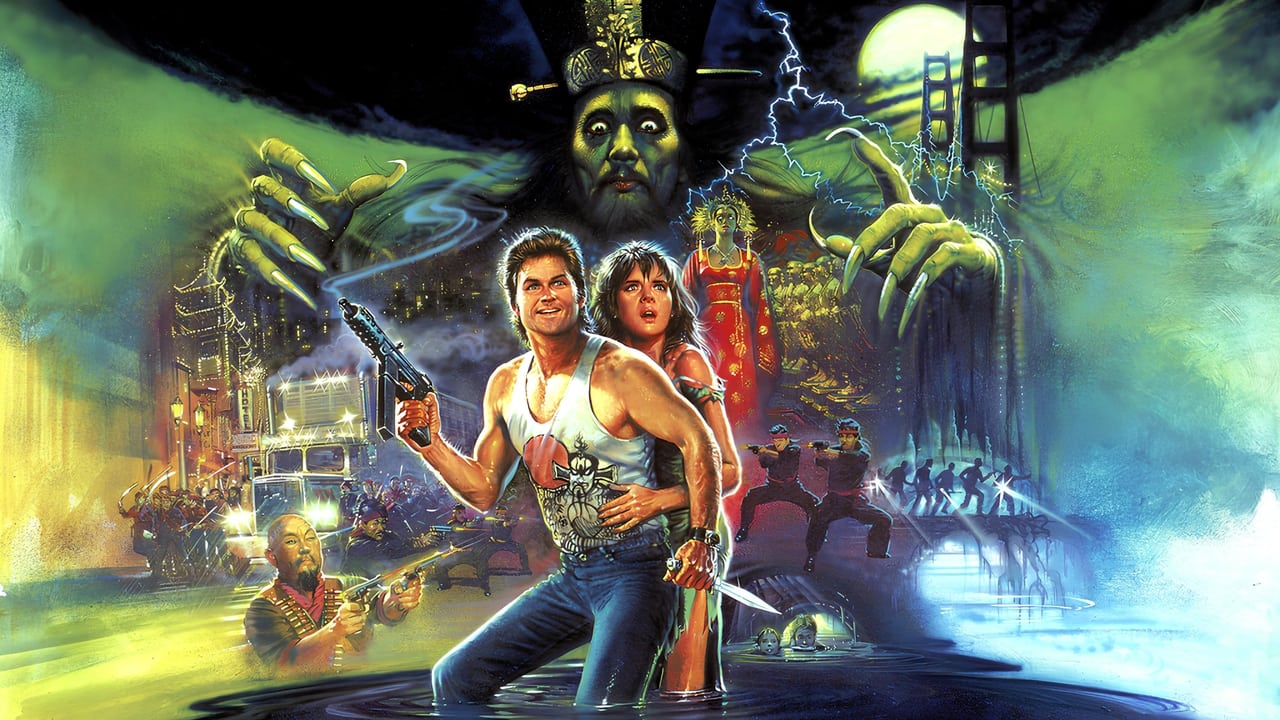
Big Trouble in Little China
Directed by John Carpenter
Plot & Narrative Analysis
The first thing Big Trouble in Little China does is lie to you about what kind of film it is. Jack Burton opens the story as its apparent protagonist — loud, confident, mouthing off on a CB radio about his own mythology — and the opening act sets up what looks like a familiar structure: the rough-edged American hero drops into an exotic situation and proves his worth through grit and improvisation. Carpenter then systematically dismantles that expectation across the next ninety minutes, revealing that Jack is not the hero of this story. Wang Chi is. Jack is the sidekick who doesn't know he's a sidekick.
This inversion is the film's central structural gambit and its richest source of comedy. Jack talks a great deal about what he's going to do, and then either accidentally accomplishes it or has to be rescued. He fires his gun at the first sign of supernatural threat and is immediately knocked unconscious by the ricochet. He charges into battle and falls through a trapdoor. He delivers stirring declarations of intent to empty rooms. Meanwhile, Wang Chi is dispatching enemies with genuine martial skill, making the critical decisions, and keeping his head in every crisis. The film is entirely aware of this dynamic — it's not a mistake in the storytelling, it's the whole point.
Beneath the genre-play, the film operates as a genuine supernatural thriller with a coherent internal mythology. Lo Pan's 2,000-year curse is specific and stakes-laden: cursed by the First Sovereign Emperor to wander the earth as a disembodied spirit, he can only regain physical form by marrying a green-eyed woman and sacrificing her to his dark lord, Ching Dai. The film commits to this mythology without irony, which is what makes it land. If the threat isn't real, the comedy collapses. Carpenter keeps the Three Storms genuinely threatening — these are not bumbling henchmen but elemental sorcerers with distinct, uncanny abilities — and James Hong plays Lo Pan as a creature of genuine malevolence wrapped in a thin skin of geriatric theater.
The film's structure also has the shape of a classic descent narrative: Jack and Wang literally go underground, into Lo Pan's fortress beneath Chinatown, a world with its own architecture, population, and logic. The above-ground Chinatown is itself already a hidden world within the grid of San Francisco; the tunnels beneath it are a world within a world, a kind of underworld that operates on dream-logic and ancient power. The climactic battle in Lo Pan's inner sanctum — with its dissolving walls and supernatural energy — feels genuinely mythic rather than merely spectacular.
What holds the comedy and the mythology together is the film's central emotional truth: Wang Chi loves Miao Yin with a devotion that neither ancient sorcery nor Wang's own death can deflect. The film treats this love with complete sincerity even as it surrounds it with absurdity, and it's this sincerity that gives the chaos its weight. When the film ends with Miao Yin safe and Wang's declaration that their wedding will be the most spectacular in Chinatown history, it has actually earned the feeling. Jack drives off alone into the night, still telling his own story on the CB, still failing to understand that he was in someone else's all along.
"You know what ol' Jack Burton always says at a time like this? Who?"Jack Burton — Big Trouble in Little China, 1986
Critics Consensus
"Brimming with energy and packed with humor, Big Trouble in Little China distills kung fu B-movies as affectionately as it subverts them."
— Rotten Tomatoes Critics Consensus
Thematic Drivers
THEME 01
The Subverted Western Hero
Jack Burton is constructed as a parody of the American action hero archetype — the laconic, self-sufficient man of action who solves problems through swagger and physical capability. The film borrows every surface signifier: the trucker's CB radio monologues, the sleeveless shirt, the can-do attitude, the bottomless reservoir of confidence. Then it arranges every situation so that Jack's attributes are useless and his interventions either accidental or counterproductive. He is, as Carpenter has noted, a Clint Eastwood character dropped into a world where he cannot function. The joke never gets old because the film never breaks character about it — Jack remains entirely sincere in his self-assessment even as the evidence accumulates.
THEME 02
East Meets West — Collision of Mythologies
The film stages a genuine collision between American pop-culture mythology and Chinese supernatural folklore, and crucially refuses to position one as the real and the other as the exotic backdrop. The Chinese mythology is presented as the actual operating system of the world — it predates American culture by millennia and functions with complete internal consistency. Jack's Western assumptions (guns solve problems, heroism is personal, individual capability is sovereign) are tested against a situation where these assumptions are simply wrong. The film doesn't condescend to Chinese culture; it makes it the lens through which American heroism is found wanting.
THEME 03
Hidden Worlds & Layers of Reality
Chinatown is physically present in the film as a place of genuine double-ness: a visible surface neighbourhood above, an ancient, populous supernatural underworld below. This geography is both literal and thematic. The film asks the audience to consider that beneath the legible surface of the modern American city — beneath tourist Chinatown, its restaurants and souvenir shops — there are entire civilisations of meaning and power that American culture is structurally unable to perceive. Jack cannot see these layers because his cultural formation gave him no tools for it. Wang Chi can navigate both worlds because he lives in both. The underworld is a figure for everything that the dominant culture doesn't see because it isn't looking.
Key Characters
Jack Burton
Kurt Russell
False ProtagonistJack Burton is one of Hollywood's great comedic constructions: a man entirely convinced of his own heroism who is structurally incapable of enacting it. He arrives in Chinatown as an accident of circumstance — his truck is stolen after Wang loses their bet — and spends the rest of the film being propelled through events rather than driving them. His self-narration, delivered via CB radio in the film's framing device, is the monologue of someone imposing a genre onto a situation that refuses to fit. He wants to be in a Western; he has stumbled into a Chinese ghost story. What makes the character work is Kurt Russell's absolute sincerity — Jack is never in on the joke. Russell gives the role the full weight of genuine heroic conviction, which makes the gap between self-image and reality genuinely funny rather than cruel. Jack's arc, such as it is, is not one of growth — he leaves unchanged, still telling his own story into the CB, still unaware that Wang's story was the one worth telling. That refusal to give him a redemptive arc is one of the film's bravest choices.
Wang Chi
Dennis Dun
True ProtagonistWang Chi is the film's actual hero, a fact the film is completely clear-eyed about even as it situates him in the structural position of sidekick. He is a skilled martial artist, a man of genuine emotional depth, and the character whose stakes drive the entire narrative — Miao Yin is his fiancée, his love for her is the engine of the plot, and it is his knowledge of Chinatown's hidden world that makes every successful action possible. Dennis Dun plays Wang with a quality of warm, capable certainty that is the exact inverse of Jack's bluster: where Jack talks about what he'll do, Wang does it, quietly and effectively. The film's choice to let Wang occupy the hero position without making a formal announcement about it — without ever having Jack explicitly acknowledged as secondary — is part of what makes the inversion so elegant. Wang is simply better at this, in every scene, and the film trusts the audience to notice.
Lo Pan
James Hong
Ancient SorcererDavid Lo Pan is one of the great villain constructions of 1980s genre cinema, and it is largely James Hong's achievement. The character exists in two physical registers: the ancient, hunched cripple in the wheelchair, wrapped in fragility and irascible dignity, and the towering supernatural entity who manifests when his power is fully summoned — robes whipping in conjured wind, voice dropped to a register that seems to come from somewhere older than the scene. Both versions are recognisably the same being, and Hong navigates the tonal gap between them with total commitment. Lo Pan's fundamental tragedy — two thousand years trapped outside physical reality, waiting for the specific conditions to break a curse laid by a god — is played with genuine pathos beneath the menace. He is monstrous, but also comprehensibly driven. His condescension towards Jack is not theatrical villainy; it is the authentic contempt of a 2,000-year-old for someone who doesn't know what year it is.
Gracie Law
Kim Cattrall
Lawyer & ActivistGracie Law functions in part as a corrective to the film's potential condescension — she is an American outsider who has taken the time to actually understand the world she's in. As a lawyer working on behalf of Chinese immigrants, she has engaged with Chinatown's realities on their own terms, and her competence and knowledge consistently outstrip Jack's. Kim Cattrall plays her with an enjoyable directness: Gracie is never wide-eyed about the supernatural elements she encounters, treating each new revelation as a problem to be solved rather than a terror to be overcome. Her chemistry with Russell is built on a kind of exasperated mutual recognition — they are both mouthy, confident people, but she is actually right about things with some regularity. The film gives her more genuine agency than most female characters in 1980s action comedy, which is partly a product of the subversive structure: in a film where the nominal hero is useless, the traditional hierarchy of competence gets reshuffled across the board.
Egg Shen
Victor Wong
Sorcerer & GuideEgg Shen is the film's most carefully calibrated figure: a tour bus driver in the daylight economy of Chinatown, and a genuine wizard when the sun goes down. He has been fighting Lo Pan for years, quietly and without recognition, and his knowledge of the supernatural landscape beneath Chinatown makes him the group's actual tactical intelligence. Victor Wong brings to the role a quality of slightly impish wisdom that never tips into caricature — Egg Shen is funny, but the film ensures he is always taken seriously as a practitioner of real power. His potions work, his protective spells hold, his knowledge of Lo Pan's weaknesses proves decisive. He occupies, structurally, the role that Egg Shen would occupy in a Hong Kong wuxia: the sifu, the keeper of knowledge, the one who has been preparing for this confrontation. That he drives a tour bus as his day job is the film's most pointed observation about how American society positions expertise it doesn't have a category for.
Analytical Themes
What the Film Is Really About
Five thematic currents that run through Big Trouble in Little China, threading its comedy and mythology into something stranger and more durable than the genre vehicle it appeared to be.
The Myth of the Competent American
Jack Burton is the film's most sustained argument, and it is an argument made through comedy rather than polemic. He embodies a specific kind of American self-mythology: the idea that the right man in the right situation, armed with enough confidence and physical capability, can impose his will on any problem. This belief is the operating system of the Western, the action film, and a significant portion of American foreign policy. Carpenter takes it seriously enough to construct a character who genuinely holds it, and then places that character in a situation designed to reveal its inadequacy.
The supernatural elements are not incidental to this argument — they are its mechanism. Jack's worldview cannot accommodate Lo Pan because Lo Pan operates on axes of power that Jack's cultural formation doesn't include. Guns don't work against a disembodied sorcerer. Confidence doesn't impress someone who has been accumulating grievances since before the founding of Rome. The film uses the supernatural to defamiliarise American competence, to make it look strange and limited. Every time Jack pulls the trigger and misses, every time he charges forward and falls through a floor, the film is demonstrating that a set of assumptions about how heroism works are simply inapplicable here.
The crucial detail is that the film never punishes Jack for this — he survives, he gets the kiss, he drives away intact. It's a surprisingly generous conclusion. The critique isn't aimed at Jack personally; it's aimed at the genre conventions that produced him and the culture that found those conventions self-evidently true.
The Curse as Cosmic Bureaucracy
Lo Pan's situation is simultaneously terrifying and absurd: two thousand years of disembodied existence, waiting for the arrival of a green-eyed woman while history scrolls past. Carpenter treats this as the film's emotional backstory rather than its comic premise. Lo Pan's desperation to break the curse — to finally occupy a real body, to have weight and substance in the physical world — is presented as genuine anguish, and James Hong plays it that way. The curse is a cosmic bureaucratic trap: specific, arbitrary, and inescapable by any means other than the prescribed ritual.
This structure has antecedents in both Chinese mythology and Shakespearean tragedy. The conditions of Lo Pan's curse parallel the riddling prophecies of Macbeth — specific enough to seem satisfiable, designed to produce exactly the kind of overreach they appear to prevent. The green-eyed woman requirement is so precise as to feel like a test rather than a solution; and like all such tests, it is one that Lo Pan cannot pass cleanly because his methods — abduction, sacrifice, domination — are themselves evidence of the corruption the curse was meant to address.
The film's deepest implication is that Lo Pan's 2,000 years of suffering have not made him wiser or more sympathetic — they have merely made him more desperate. His villainy is the logical endpoint of immortality without growth. There is something genuinely melancholy in the moment of his death: a man who survived two millennia, undone in seconds by a thrown knife, in a world that has moved so far past him that his ancient powers barely registered against it.
Genre Fusion as Political Act
Big Trouble in Little China belongs to a tradition of genre-fusing that uses formal hybridity as a political tool. By layering the American action-comedy over Hong Kong wuxia, Carpenter creates a text that cannot be read cleanly from either tradition — each genre's conventions keep defamiliarising the other. The audience accustomed to action-comedy expects Jack to be competent; the audience familiar with wuxia knows that the real fighters here are Wang Chi and Egg Shen. The film's commercial failure in 1986 was in part a failure of this kind: American audiences expected a film that confirmed their genre expectations, and were given one that gently mocked them.
The political dimension is in the visibility this fusion creates. By centering Chinese characters in their own narrative — giving Wang Chi the hero's journey, giving Egg Shen the tactical intelligence, treating the mythology as real rather than decorative — the film implicitly criticises Hollywood's standard treatment of Asian settings as exotic backdrop. The Chinese characters in Big Trouble are not supporting players in Jack's story. They are the story, and Jack wanders through it, largely uncomprehending, as a figure for the culture that would normally place him at the centre.
Love as the Only Operative Motivation
The film is, at bottom, a love story — and not the love story it appears to be setting up. Jack's attraction to Gracie is treated as a secondary plot line, charming but essentially decorative. The emotional centre of the film is Wang Chi's love for Miao Yin, and it is played completely straight. Wang is not fighting Lo Pan because it is heroic or exciting; he is fighting because the woman he intends to marry has been taken, and the specific quality of his love for her — patient, committed, physically courageous — is the only thing in the film that the supernatural forces cannot manipulate or diminish.
This is a classical wuxia structure: the warrior's power derives not from technique alone but from the moral clarity of his motivation. Wang fights well because he fights for something real, and Lo Pan, whose motivations are entirely self-serving, is revealed as brittle precisely in the moment that should be his triumph. His own greed and the specific conditions of his curse become the instruments of his defeat: he selects the wrong woman, splits his attention, and is undone by the precision of the very ritual he designed to save himself.
Miao Yin is the least-developed character in the central drama — she is more emblem than person — but the film's structure requires her to function as a genuine stake rather than a mere MacGuffin. Wang's behaviour makes this work: the depth of his feeling gives her weight that the script alone doesn't provide. When they are reunited, the film has earned a moment of uncomplicated relief.
Luck, Skill, and the Illusion of Mastery
"It's all in the reflexes" is Jack's most-repeated line, delivered after each accidental success, and it functions as the film's ironic motto. The phrase implies a causal connection between Jack's innate capability and the outcomes he experiences; the film relentlessly demonstrates that the connection is non-existent. Jack's reflexes are not what save him. Wang's skill saves him. Egg Shen's preparation saves him. Gracie's determination saves him. Jack contributes luck, which the film treats as a genuine force — the knife that kills Lo Pan is thrown on instinct, and it lands — but luck is specifically not the same as mastery.
The film is interested in the difference between competence and the narrative of competence. Jack has a very complete narrative of his own competence; the film persistently shows that narrative to be unsupported by evidence. This is not a critique of Jack's character so much as a critique of the genre that produced his self-image. Action films train audiences to read luck as skill, accidents as intention, and survival as proof of worthiness. Big Trouble separates these conflations carefully, making sure the audience can always see the gap between what Jack thinks is happening and what is actually happening.
The final image — Jack alone in his truck, back on the CB, telling the story his way — is both funny and melancholy. Nothing has changed. The narrative of competence is intact. The adventure he just survived has been processed into further evidence of his own heroism. In that sense, the film ends on a note of genuine psychological acuity: the self-image survives reality because it always does, because that is what self-images are for.